

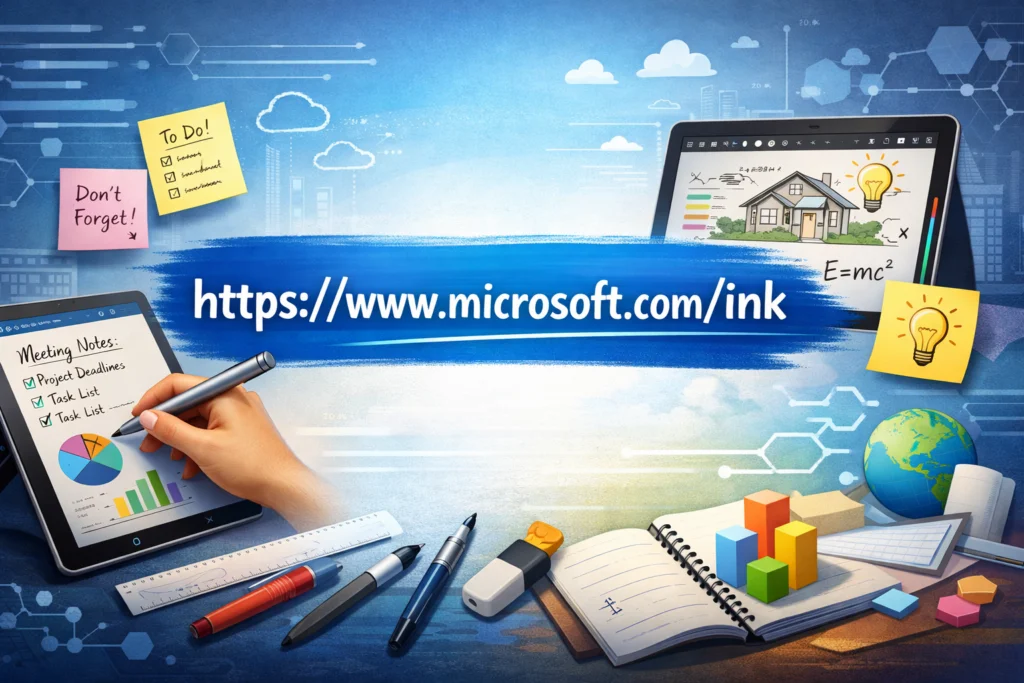
Microsoft Ink (often discovered through https //www.microsoft.com /ink pages and Windows features) is the name most people give to Microsoft’s suite of digital inking technologies: handwriting recognition, stylus support, drawing surfaces, and developer APIs that let apps accept natural pen input. In plain terms, it’s the glue that makes pens feel delightful on screens — whether you’re scribbling a quick note, annotating a PDF, sketching an idea, or marking up a slide. This article walks you through what Microsoft Ink is, how it works at a practical and technical level, where it shines in real workflows, and how to get the most out of it as a user or developer. The tone is casual but knowledgeable — think of a friendly guide from someone who’s spent way too much time https //www.microsoft.com /ink testing pens on tablets.
Understanding Microsoft Ink begins with appreciating the core promise: a pen should be a natural, low-friction input method that augments typing and touch, not competes with them. That promise shows up in several places: latency reduction so strokes feel immediate, pressure and tilt sensitivity so lines express nuance, conversion of handwriting to text so notes become searchable, and integration with apps so ink becomes a first-class citizen across documents and whiteboards. Microsoft’s implementations aim to make these capabilities available both for end-users (Surface and other Windows devices) and for developers who want to embed expressive pen input into their apps. The result is a surprisingly broad set of experiences — from quick sticky notes to collaborative whiteboard sessions.
If you’re new to pen-first computing, the simplest way to think about Microsoft Ink is as a translation layer and toolkit. It translates the physical act of drawing and writing into digital strokes, metadata (pressure, angle, speed), and optional recognized text https //www.microsoft.com /ink or shapes. It also provides the building blocks for apps to react to those strokes in intelligent ways: smoothing lines, converting to vector shapes, recognizing math, or replaying an inked animation. Because of this, Microsoft Ink does two things at once: it preserves the expressive, human qualities of pen work (scribble, flourish, scrawl) while enabling machine-friendly benefits (search, edit, structure). That dual nature—organic plus computable—is where the platform’s value really sits.
Finally, while the brand “Ink” can appear in multiple product names (Windows Ink, Ink Editor, Microsoft Whiteboard, pen support in Office apps), the experience you get depends on context: the hardware (pen type and screen), the software (an app built to consume ink), and the platform services (handwriting recognition, synchronization). This article covers those variables in context, focusing on practical outcomes and tips so you can get more done with your pen instead of fighting it.
What Microsoft Ink Actually Is — Components & Philosophy
Microsoft Ink is not a single monolithic product you download; it’s a family of technologies and design principles baked into the OS, productivity apps, and developer kits. At a low level you have the raw input pipeline: the digitizer/hardware captures point https //www.microsoft.com /ink data (x/y coordinates) and associated attributes (pressure, tilt, timestamp). The OS and drivers turn that into a stream of “ink strokes” which can be rendered, stored, or passed on to recognition engines. On top of that, Microsoft layers services that interpret or enhance those strokes — smoothing, shape recognition, handwriting-to-text conversion, and more. For users this is mostly invisible, but it’s the architecture that lets one app treat ink differently than another without losing https //www.microsoft.com /ink the original pen data.
More than code and APIs, Microsoft Ink is a design philosophy: preserve the human trace and don’t force it into rigid digital forms unless the user asks. That’s why ink experiences often default to retaining the original strokes even when text conversion is offered as an option. This preserves intent — the speed, pressure, and shape that convey meaning — while still allowing machines to help (search, edit, translate). That balance is important: when ink is too aggressively auto-corrected or converted, you lose the immediacy that made the pen useful in the first place.
Another component is the integration points: Office apps like Word, PowerPoint, and OneNote expose dedicated ink toolsets — pens, highlighters, rulers, and lasso-selection tools — so ink becomes part of the document editing flow. There are also system-level features; for example, quick note panels, handwriting input editors, and touch-friendly drawing canvases. For developers, Microsoft provides APIs and SDKs so that native apps can accept and operate on ink strokes, letting teams build everything from signature capture tools to collaborative whiteboards. These integration points are what turn ink from a novelty into a workflow staple for many creative and knowledge workers.
Finally, consider accessibility and inclusion. Ink isn’t only for artists or designers; for many people with fine-motor skills, writing by pen is more comfortable than typing. Microsoft’s approach often includes handwriting recognition that supports multiple languages and scripts, making pen input a real alternative for people who prefer writing in their native script or those who rely on handwriting for cognitive reasons. The guiding idea is simple: let people use the input method that feels most natural — the platform should adapt to the person, not the other way around.
Evolution & Key Features — What Makes Ink Useful Today
The inking experience has matured from basic “draw-on-screen” tools to nuanced, context-aware features that enhance productivity. Early digital https //www.microsoft.com /ink ink was raw: you scribbled and the system stored a bitmap. Modern ink adds intelligence: stroke smoothing that preserves character while removing jitter, palm rejection so your hand doesn’t create accidental marks, and pressure/tilt sensitivity that lets a stylus act like a brush. These quality-of-life improvements make writing and drawing feel real—crucial for adoption. Without them, the pen feels like a clumsy finger substitute instead of a dedicated instrument.
Recognition capabilities are another major evolution. Handwriting-to-text conversion has improved dramatically: not only can systems convert neat printed handwriting, they can often handle cursive and mixed handwriting styles, then make the content searchable and editable. Shape recognition works similarly: quick rough circles and rectangles can become precise shapes that are easier to manipulate and align. For meetings and brainstorming sessions, this means messy whiteboard sessions can later be converted into tidy diagrams without losing the original creative sparks.
Interoperability and synchronization round out the modern experience. Ink captured on a Surface device can sync across Microsoft’s ecosystem: saved in OneNote, exported to a PowerPoint slide, or shared in Microsoft Whiteboard for remote collaboration. That synchronization means the value of a quick sketch isn’t trapped on a single device — it becomes shareable and persistent. Similarly, integration with cloud services enables collaborative editing where multiple people can ink over the same canvas in real-time, each stroke appearing as if it were drawn live.
Finally, we’re seeing smarter developer tooling. APIs let apps capture the raw ink stream (so you never lose fidelity) and also offer pre-built recognition services so teams don’t need to reinvent the wheel. This lowers the barrier for creating specialized inking apps — for example, a math tutoring app that recognizes equations or a design review tool that captures markups as structured comments. Combined, these improvements have shifted ink from https //www.microsoft.com /ink nicety to necessity for many creative, educational, and enterprise workflows.
How Microsoft Ink Works — Technical and UX Mechanics
At the hardware layer, a modern ink system needs three things: a responsive digitizer, an expressive pen, and driver/firmware that report attributes reliably. The digitizer samples the pen position many times per second; higher sampling rates reduce apparent latency and make the stroke feel immediate. A pen that reports pressure and tilt gives apps more expression — thinner lines with lighter pressure, broader strokes when tilted — which is essential for artistic uses. Finally, firmware and drivers harmonize pen signals with OS-level gestures (like touch scrolling) so both pen and finger input can coexist gracefully.
Above the hardware, the OS provides a stroke model: a compact representation of ink made of points, timestamps, and optional attributes (pressure, tilt). This model allows apps to replay, edit, search, and render ink consistently. Rendering typically uses vector paths generated from these sampled points, sometimes augmented by smoothing and stroke stylization algorithms. Because strokes are vector-ish rather than raw bitmaps, they’re resolution-independent and can be scaled or transformed without losing quality — a huge win for note-taking and diagramming.
Recognition engines are where semantics get extracted from strokes. Handwriting recognition maps stroke sequences to characters and words; it often uses machine learning models trained on a variety of handwriting styles and languages. Shape recognition looks at stroke geometry and timing to decide whether the user intended a circle, rectangle, arrow, or freeform doodle. Some systems also perform on-device recognition for privacy and responsiveness, while offering cloud-based recognition for more complex tasks or larger language models.
Finally, on the UX side, a few design patterns make ink feel natural: immediate visual feedback (show strokes as they’re drawn), non-destructive workflows (always keep the original ink until the user chooses to convert), and easy switching between ink tools (pen, highlighter, eraser, lasso). Gesture affordances—double-tap to change tools, press-and-hold to pop up pen menus—help power users move quickly. For developers, exposing these UX hooks while maintaining consistency with platform-wide behavior is key to building experiences that feel native and https //www.microsoft.com /ink predictable.
Practical Uses & Workflows — Where Ink Adds the Most Value
Note-taking is the most obvious use case, but ink shines beyond that. In meetings, quick sketches communicate structure and relationships far faster than typed bullets. A diagram drawn in a few strokes can be clearer than a paragraph of text. This immediacy makes pen input especially powerful for whiteboarding, where the goal is exploration https //www.microsoft.com /ink rather than polished output. Teams can capture that rapid ideation, then convert or refine the best ideas later — keeping the creative energy intact.
For design and creative work, pen input offers precision and nuance. Illustrators and designers use pressure and tilt to create varied strokes; product teams use inking to annotate mockups with handwritten notes and arrows that communicate intent more directly than typed comments. In annotation workflows—PDF review, code review screenshots, or UX critiques—inking provides a fast way to mark issues, suggest changes, and highlight important areas without breaking the flow to type a formal comment.
Education is another area where ink has a disproportionate impact. Math and science teachers often prefer handwriting for equations and diagrams. Tools that recognize and convert mathematical notation can help students check work or transform handwritten solutions into typed expressions for grading. For learners with dyslexia or other language-related challenges, handwriting can sometimes be more natural than typing, and ink-enabled tools that assist with recognition and correction can make learning more inclusive.
Finally, in field or hybrid work scenarios—medical notes, architectural site visits, or logistics—pen input on a tablet can be faster and more ergonomic than lugging a laptop. Signatures, quick diagrams, checklists scribbled in the margins: these small interactions add up to big productivity gains when the device supports quick ink capture and syncs reliably back to central systems.
Tips & Best Practices — Get More Done with Your Pen
Choose the right pen and surface pairing. Not all pens and digitizers are equal: sampling rate, supported pressure levels, and click behaviors differ. If you rely on subtle shading or pressure sensitivity, test pens and displays for responsiveness before committing. Cheap styluses may work for casual notes but will disappoint artists or heavy note-takers https //www.microsoft.com /ink. If you use a Surface device or other pen-optimized hardware, keep firmware updated — manufacturers often improve latency and palm rejection via updates.
Organize ink so it’s retrievable. One of ink’s best features is its ability to be converted and searched — but that only helps if you organize notes thoughtfully. Use consistent notebooks, tags, or titles in apps like OneNote or OneDrive. If you frequently convert handwriting to text, adopt short consistent abbreviations or headings so recognition engines have clear anchors. When you scan or import ink from other sources, consider adding a short typed summary for future searchability.
Use non-destructive conversion workflows. Whenever possible, keep the original ink even after converting to text or shapes. Many apps offer “retain ink” toggles that let you see both the original strokes and the converted output — this is helpful when the conversion isn’t perfect and you need to refer back to the original handwriting for nuance. Also, avoid automatic conversions in shared or collaborative settings unless everyone agrees; conversions can sometimes misinterpret shorthand that only the original author understands.
Learn a few power gestures and shortcuts. Most inking ecosystems include quick gestures: lasso-select to move ink, long-press to open tooltips, or double-tap to switch pen modes. Master these small maneuvers — they dramatically speed up common tasks. Also use simple conventions in meetings: underline to emphasize, star to mark action items, or https //www.microsoft.com /ink box items that require follow-up. These visual cues can be recognized by later review or even by automated helpers that scan for action items.
For Developers — Building with Ink (Practical Guidance)
If you’re building an app that needs pen input, start by capturing the raw stroke data model rather than an image. Raw strokes preserve the richness of the input (timestamps, pressure, tilt) and enable downstream features like replay, conversion, and analytics. Expose both raw and processed representations — raw for fidelity, processed for convenience. This approach keeps future options open: you can later add recognition or cloud-based processing without having to re-capture the input.
Design for incremental recognition. Don’t block the user’s workflow while waiting for a heavy recognition pass to finish. Provide immediate visual rendering and offer recognition as an optional enhancement or background task. If you do use cloud recognition, surface confidence levels and allow users to correct mistakes easily. A helpful pattern is to show a “suggested conversion” that the user can accept, edit, or reject.
Respect privacy and offline scenarios. Some recognition tasks can and should run locally to protect sensitive content and reduce latency. Offer on-device recognition where possible and make cloud processing opt-in. Document what data you collect and how it’s used; users whose notes might contain sensitive or proprietary information will https //www.microsoft.com /ink appreciate clear, secure defaults.
Finally, build accessible ink experiences. Pen input can be invaluable for people who find typing challenging, so ensure your ink-enabled app integrates with accessibility APIs. Provide alternative input paths (voice, keyboard) and ensure converted text is reachable by screen readers. Consider how color, contrast, and stroke thickness affect readability and offer customization so users can tailor the experience to their needs.
The Future of Digital Ink — Trends to Watch
Digital ink is moving from a niche input method to an integrated modality across more applications. Expect improved recognition models driven by larger and more diverse datasets, which will reduce friction for handwriting conversion across languages and scripts. Real-time collaborative ink experiences will be richer — lower latency, better synchronization, and smarter conflict resolution — making remote whiteboarding feel closer to an in-person session.
AI augmentation is another trend: imagine systems that summarize your inked meeting notes automatically, extract action items, or turn rough sketches into polished diagrams and even code. These are not far-off ideas; they’re incremental extensions of existing recognition and synthesis capabilities. The key will be maintaining the human-first feel of pen input even as machine assistance becomes more assertive: users should always keep https //www.microsoft.com /ink the final say.
Hardware will continue to improve too. Expect pens with more nuanced sensors, better battery life, and haptic feedback that simulates different pen tips. Displays will target lower latency and higher sampling rates, making the pen feel indistinguishable from a physical instrument for many tasks. Combined with improved cloud-edge architectures, this will make ink faster, smarter, and more ubiquitous.
Finally, watch for cross-platform ink ecosystems that don’t silo strokes on a single vendor’s cloud. Interoperability standards and open formats for ink data would make it easier to move notes and sketches between apps without losing fidelity. That portability would be a big win for users who switch devices often or work in mixed-tool environments.
Conclusion — Why Ink Still Matters
Microsoft Ink — and digital ink more broadly — is about more than pretty lines on a screen. It’s a bridge between human expression and digital utility. The pen captures nuance, speed, and intent; the software makes that content persistent, searchable, and shareable. When those two halves work together well, you get workflows that are both expressive https //www.microsoft.com /ink and efficient: quick idea capture that becomes organized knowledge, rough sketches that become shareable diagrams, handwritten notes that are as discoverable as typed ones.
